Re-Inventing Democracy for the 21st Century


Network Overview Video


"We need AI to make democracy work for the 21st century."

"Rather than replace democracy with AI, we must instead use AI to reinvigorate democracy, making it more responsive, more deliberative and more worthy of public trust."

Eric Schmidt, former Google Chair and CEO
New York Times, November 11, 2025


Premise of this essay: Democracy must be re-invented for the 21st Century because technology for conducting elections has become obsolete in most representative forms of government. It typically obstructs rather than promotes the expression of the "general will" of the voting population.

In contrast to the powerful capabilities of modern technology, obsolete electoral technology prevents voters from using elections to define their legislative priorities. It prevents them from nominating and electing candidates of their choice, and determining what laws are passed.

The essay's objective is to advocate the replacement of this obsolete technology with modern technology to connect millions of voters. This technology empowers voters to build consensus across partisan lines and overcome political stalemates. It enables voters to exercise their political sovereignty to determine who runs for office, who gets elected, and what laws are passed.

How this crucial paradigm shift can be achieved with modern technology in the near future is described below. This technology is indispensable for bypassing traditional reform measures and mechanisms relating to elections and legislation because of their proven inefficacy.

Global Consequences

Obsolescent electoral technology is a primary cause of the global "backsiding" of democracies documented by cross-national research. (See V-Dem Institute. Unraveling The Democratic Era? University of Gothenberg, Democracy Report 2026.)

"Nearly a quarter of the world’s nations are going through democratic backsliding, or autocratization, in 2025, and six out of the ten new autocratizing countries identified in the 2026 Democracy Report are in Europe and North America. Among them are large and influential countries like Italy, the United Kingdom, and the USA.""

This "autocratization" is propelling life-threatening global trends. They include current conflicts among nations, and within nations.

They include heads of state, governmental agencies, and policies and programs that fail to meet the needs of their constituents, and even undermine their well-being. In addition, these trends also comprise large scale popular protests, many of which are non-violent, yet others involve the use of force. Participants are driven by emergency needs, but they can also be motivated by their rejection of technologically obsolete elections and their results that appear duplicitous and even farcical.

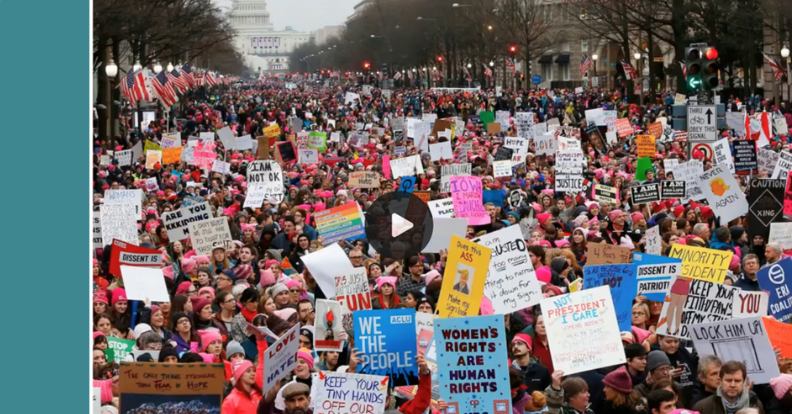
These demonstrations of popular opposition to government actions, policies, and laws are often ignored and rarely bring about the changes protestors demand. Governments dispatch law enforcers aiming to disband the protesters. Increasingly, they arrest unarmed civilians, and even use force that harms, injures, and even kills protestors.

According to the Pew Research Center, based in Washington, D.C, public trust in government has been low for three decades. "Public Trust in Government: 1958-2022." June 6, 2022.

Findings by Pew and others include the following:

Just 17% of Americans currently say they trust the government in Washington to do what is right 'just about always' or 'most of the time', one of the lowest measures in seven decades.

The 'Anger' Shift: While 'frustration' was once the dominant emotion, recent findings show a significant spike in active anger. As of late 2025, 26% of Americans describe themselves as 'angry' with the federal government, while 49% remain "frustrated.

Congress: Approximately 70% of Americans hold an unfavorable view of Congress. Responsiveness: Roughly 80% to 85% of Americans believe elected officials "don't care what people like them think.

According to critics, there is a significant underlying cause of this rejection, even among people unaware of it. It is that elections cause the transfer voters' political sovereignty to unaccountable elected lawmakers, who can ignore voters' needs and demands once they are in office.

Key components of the modern electoral technology I propose are described in a patent I was recently granted by the U.S. Patent and Trademark Office (USPTO), accessible here.

This modern technology propels elections into modern telecommunications realms, and interconnects billions of people to collaborate in managing their lives and civic participation in what is referred to as an emerging "global brain".

Many years ago, informed proponents of the global brain hypothesis asserted the following:

"The Internet increasingly ties its users together into a single information processing system that functions as part of the collective nervous system of the planet"

"The global brain is a neuroscience-inspired and futurological vision of the planetary information and communications technology network that interconnects all humans and their technological artifacts. As this network stores ever more information, takes over ever more functions of coordination and communication from traditional organizations, and becomes increasingly intelligent, it increasingly plays the role of a brain for the planet Earth."

The modernizing technology I propose enables voters everywhere to connect to each other at will within and across frontiers. They can break out of the confines of small, geographically constricted election districts, which afford them few options other than voting for candidates already on the ballot running on agendas without voters' active input.

Below I summarize in several diagrams and slides how this technology modernizes elections. It does so by providing voters digital tools and AI-based capabilities for using elections to define and continually update their priorities; and determine who runs for office, who gets elected, and what laws are passed.

Interested readers can also access a short video here, and web page here for an overview of what I am proposing.


The steps below describe how voters worldwide will be able to re-invent democracy technologically while emulating historic Swiss direct democracy practices when the network is fully operational.

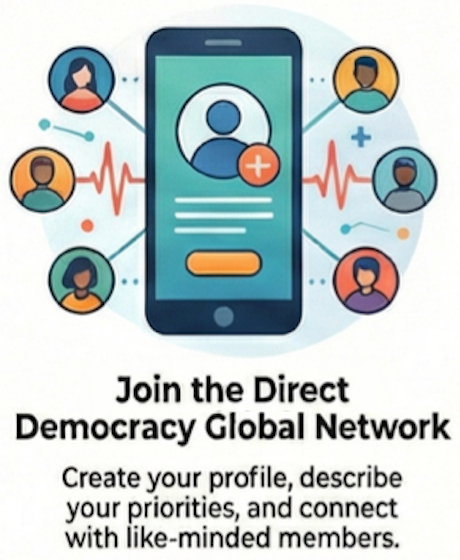
Step 1. Join the Direct Democracy Global Network

Welcome to the network! You can join free of charge by creating your home page and profile by entering your sign-in username and password.

As a network member, you can use its direct democracy information and messaging tools and services, free of charge, to connect to like-minded voters. You can define and share your priorities and legislative agendas, and collaborate to enact your agendas.

You can join forces to create online political parties, voting blocs, and electoral coalitions. You can build consensus across partisan lines to set common legislative agendas, bridge divides, and determine who runs for office, who gets elected, and what laws are passed.

Network services include conducting initiatives and referendums, as the Swiss have been doing for centuries. You can access to the network's Fact Checker and Voting Utility to cast votes on a variety of proposals.


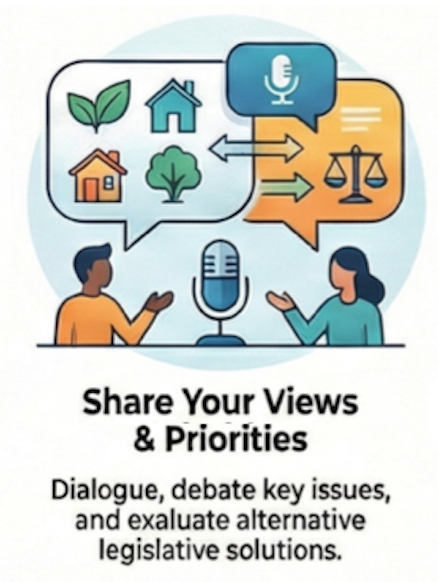
Step 2. Share Your Views and Priorities

Express your views, define your priorities, and create your own legislative agendas.

Save your priorities and agendas, and share them selectively, privately, and confidentially with individuals and groups you choose. Below are four methods.

(1) Describe any number of priorities in your own words, and set your own legislative agendas.

(2) Search the network priorities database listing priorities from a range of sources, and access web links to information about them. Select those that are similar to your own priorities, and what you want to happen legislatively.

(3) View priorities and agendas of individual network members who agree to share them, and select those you prefer. Names are not provided.

(4) Choose your legislative priorities and agendas from those of political parties, voting blocs, and electoral coalitions hosted on the network that agree to share them.


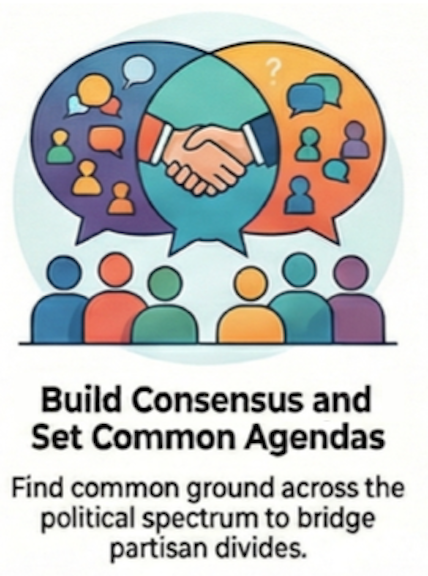
Step 3. Build Consensus and Set Common Agendas

In addition to defining your own priorities and setting your own agendas, you can connect to other network members to set common legislative agendas including priorities you share.

You can actively participate in collective efforts to build consensus across partisanlines. You can conduct online dialogues and debates, and reconcile divergent perspectives and objectives.

During your participation, you can clarify the meaning of your priorities and show how they resemble and/or diverge from other participants’ priorities. You can use the network’s Fact Checker to distinguish facts from misinformation.

You and other network participants can decide, at any point in time, to update and vote online to determine which priorities to include in common legislative agendas, using the network’s Voting Utility.


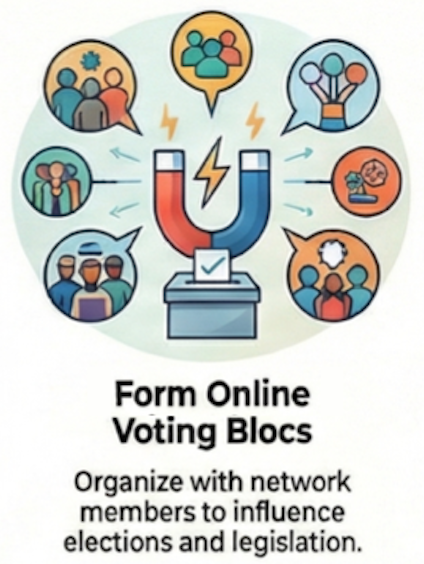
Step 4. Form Online Voting Blocs


You can collaborate with like-minded network members who espouse legislative priorities similar to yours, to take advantage of the network’s political organizing tools.


You can transform your personal networks into voting blocs and host and co-manage them on the network.

 Together you can utilize the network’s direct democracy tools and services to carry out tasks that are vital to fully functioning democracies. 


Your blocs can function uniquely online within the network, or operate outside the network in locations and forms chosen by the members.

They can choose to join existing blocs, parties, and coalitions, online and offline,
and/or opt to work independently.


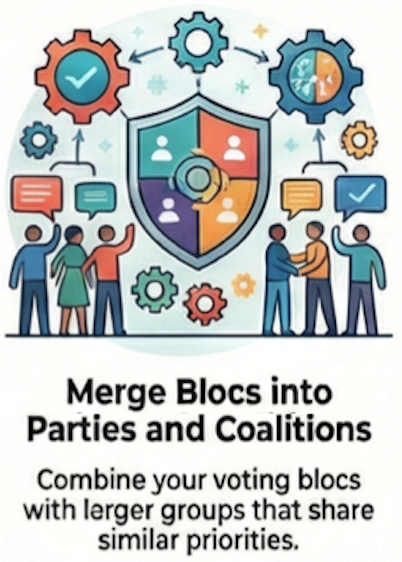
Step 5. Merge Blocs into Parties and Coalitions

You can merge your voting blocs hosted on the network with political parties and coalitions also hosted on the network, so they can build consensus across partisan lines and increase numbers of voters in their electoral base.

You can also decide to form your own political parties and electoral coalitions.

They can be organized informally, and create temporary ad hoc alliances with other parties.

In addition, you can organize them formally and register them officially with local governmental election agencies, to enable them to fully participate in electoral processes throughout election cycles.

Since their members can freely define their priorities and set their legislative agendas without regard to doctrines or ideogies, they can function autonomously and adhere exclusively to the decisions of their members.


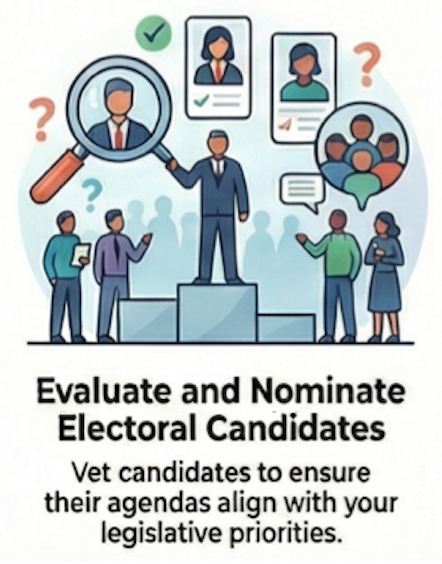
Step 6. Evaluate and Nominate Electoral Candidates

Thanks to the beneficial reversal of traditional practices, you and network voters can use the Direct Democracy Global Network to evaluate and nominate electoral candidates of your choice, rather than be limited to choosing among candidates already on the ballot.

You can collaborate with network members to identify and evaluate prospective candidates in depth, according to criteria of their choosing.

You can scrutinize candidates' prior activities, votes, and priorities to evaluate whether they align with your own priorities, and those of your voting blocs, political parties, and electoral coalitions.

In addition, you can conduct online interviews with prospective candidate, and evaluate first hand whether they appear likely to be consensus-builders if elected, and whether they will reach across partisan divides to prevent stalemates.


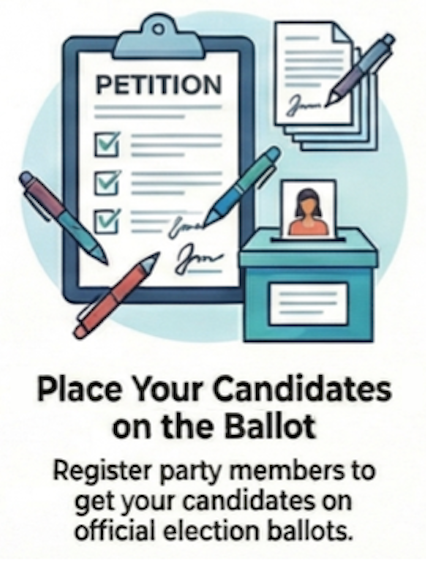
Step 7. Place Your Candidates on the Ballot

Laws, rules, and regulations for placing candidates on election ballots vary widely. They can be quite cumbersome, and require close and continuous scrutiny.

These complications can result from deliberate efforts to obstruct competitive electoral races by keeping voters from having fair chances to elect candidates of their choice.

Fortunately, there will be large numbers of election experts who are members of the Direct Democracy Global Network who will share their expertise with you and other members to ensure free and fair elections.

One of the most important steps is plan ning ahead and constantly monitoring changes in official election laws, regulations, procedures, to ensure you and network members, and your voting blocs, political parties, and electoral coalitions, are able to get your candidates' names on official primary ballots.


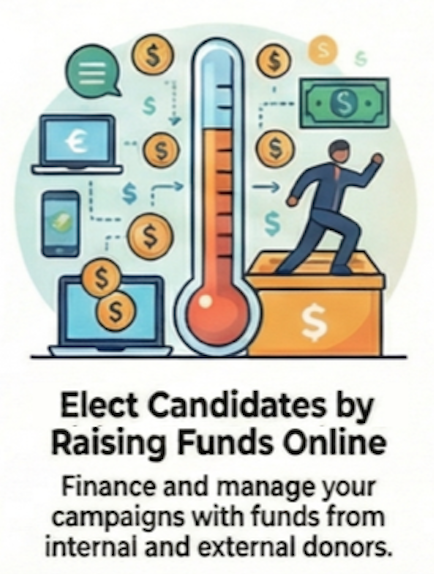
Step 8. Elect Candidates by Raising Funds Online

A strategically important key to winning elections is to raise funds to finance your campaigns that enable you to reach out to as many voters as you can. You can seek funding from sources inside and outside the network.

Billions of dollars are raised and spent during every election cycle. There are a variety of channels of communication that you can use to direct such funds to your campaigns.


The success of your fundraising efforts might be facilitated if prospective donors are informed of your membership in the Direct Democracy Global Network.


Increasing numbers of politically engaged individuals, groups, and organizations are devoting their time, energy, and donations to strengthening and re-invigorating democratic electoral and legislative processes and institutions.


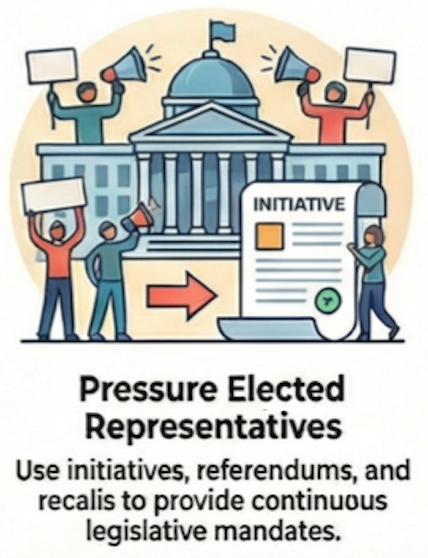
Step 9. Pressure Elected Representatives

You and the network members of your political parties, voting blocs, and electoral coalitions can actively participate in post-election decision-making in all branches of government, by using direct democracy tools provided by the network.


You can conduct petition drives, referendums, initiatives, and recall votes, publicize the results, and use them to transmit written mandates to decision-makers during all phases of governmental decision-making processes.


These mandates will reflect the needs and demands of the public and their constituents during all phases of post-election decision-making.


Your capabilities and those of network members to determine the outcomes of past and future elections will prompt decision-makers to heed your demands.


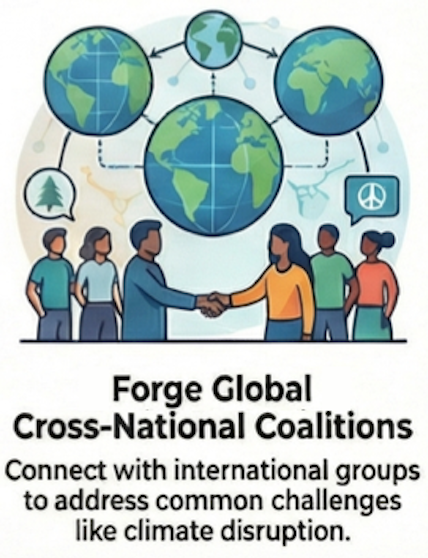
Step 10. Forge Cross-National Coalitions

You can join with network members to design and implement life-preserving policies and plans, such as curbing climate disruption, and collectively devising common peace-making plans worldwide.

By connecting online with network members and voters where you live, as well as across nation-state frontiers, you can collaborate to design and enact peace-making plans to resolve confrontations and conflicts worldwide.

Voters living in different countries often experience similar needs, crises, and emergencies, even though their governments may tend to disagree.

You can use the network to connect to voters with experiences similar to yours. Network tools enable you to collectively create online political parties, voting blocs, and electoral coalitions dedicated to peace-making.


You can use network agenda-setting, political organizing, and electoral tools to create common fronts to induce lawmakers to enact common peace-making plans, within and across frontiers.


Resources

Bordier, N.J. 2024. Decision Assisting Artificial Intelligence System for Voter Electoral and Legislative Consensus Building USPTO Patent No.: US 11,935,141 B2.

Kuzminisky, Adrian. 2008. Fixing the System. A History of Populism, Ancient and Modern". Continuum International Books.

Ostrom, Elinor. 1990. Governing the Commons: The Evolution of Institutions for Collective Action. Cambridge University Press.

Pew Research Center. 2022. "Distrust, Discontent, Anger and Partisan Rancor The People and Their Government." June 6, 2022. Washington, D.C.

Polonski, Vyacheslav. 2017. "The Good, the Bad and the Ugly Uses of Machine Learning in Election Campaigns.” Centre for Public Impact (CPI). 30 August 2017.

Russell, Peter. 1983. The Global Brain: speculations on the evolutionary leap to planetary consciousness. Los Angeles: JP Tarcher.

Shirky, Clay. Here Comes Everybody: The Power of Organizing Without Organizations. Penguin Group. Wikipedia.

Sievers, Beau, et.al. 2022. "How Consensus-Building Conversation Changes Our Minds and Aligns Our Brains" Europe PMC. September 17, 2022.

Sunstein, Cass. 2009. Going to Extremes: Sunstein’s Take On How Like Minds Unite and Divide | Evidence-Based Methods for Inter-Group Civility. Oxford University Press, USA . CivicPolitics.org.

V-Dem Institute. 2026. Unraveling The Democratic Era? University of Gothenberg, Democracy Report 2026.

Waller, Lewis. 2023. How Switzerland Changed the World.

Swiss Federal Department of Foreign Affairs (FDFA)

"Direct democracy is one of the special features of the Swiss political system. It allows the electorate to express their opinion on decisions taken by the Swiss Parliament and to propose amendments to the Federal Constitution. It is underpinned by two instruments: initiatives and referendums.

"In Switzerland the people play a large part in the decision-making process at all political levels. All Swiss citizens aged 18 and over have the right to vote in elections and on specific issues. The Swiss electorate are called on approximately four times a year to vote on an average of fifteen such issues.

"Citizens are also able to propose votes on specific issues themselves. This can be done via an initiative, an optional referendum, or a mandatory referendum. These three instruments form the core of direct democracy."

Popular initiative

"The popular initiative allows citizens to propose an amendment or addition to the Constitution. It acts to drive or relaunch political debate on a specific issue. For such an initiative to come about, the signatures of 100,000 voters who support the proposal must be collected within 18 months. The authorities sometimes respond to an initiative with a direct counter-proposal in the hope that a majority of the people and the cantons support that instead."

Optional referendum

"Federal acts and other enactments of the Federal Assembly are subject to optional referendums. These allow citizens to demand that approved bills are put to a nationwide vote. In order to bring about a national referendum, 50,000 valid signatures must be collected within 100 days of publication of the new legislation."

Mandatory referendum

"All constitutional amendments approved by Parliament are subject to a mandatory referendum, i.e. they must be put to a nationwide popular vote. The electorate are also required to approve Swiss membership of specific international organisations."

Swiss Confederation: Political System

"Switzerland is governed under a federal system at three levels: the Confederation, the cantons and the communes. Thanks to direct democracy, citizens can have their say directly on decisions at all political levels. This wide range of opportunities for democratic participation plays a vital role in a country as geographically, culturally and linguistically varied as Switzerland."

"Since becoming a federal state in 1848, Switzerland has expanded the opportunities it provides for democratic participation. Various instruments are used to include minorities as much as possible — a vital political feature in a country with a range of languages and cultures. The country’s federal structure keeps the political process as close as possible to Swiss citizens. Of the three levels, the communes are the closest to the people, and are granted as many powers as possible. Powers are delegated upwards to the cantons and the Confederation only when this is necessary."


Contact

Century21@reinventdemocracy.net

Copyright © 2026 Direct Democracy Global Network
All Rights Reserved